
A malfunctioning commercial refrigerator can disrupt operations, compromise food safety, and lead to costly inventory losses—especially in Singapore’s heat and humidity. Whether you’re noticing unusual noises, fluctuating temperatures, or excessive frost buildup, knowing the warning signs of refrigerator failure is essential. In this guide, we break down everything you need to know about commercial refrigerator repair—from common repair indicators and expected repair costs in Singapore to problem-specific pricing, including walk-in cooler service fees. We’ll also explore ways to avoid unexpected expenses, explain the difference between DIY and professional maintenance, and show how KnQ Fatt’s repair team supports local businesses with timely, transparent, and efficient refrigeration services. If your unit is acting up—or you haven’t serviced it in months—this guide will help you make informed, cost-effective decisions.
A commercial refrigerator is the backbone of any food business in Singapore, whether you’re running a restaurant in Tanjong Pagar or managing a bakery in Jurong. When these essential appliances falter, they often show warning signs long before a full breakdown occurs. Ignoring these signs can lead to spoiled inventory, business interruptions, and costly emergency repairs. Below are critical signs that indicate your commercial refrigerator needs immediate attention:
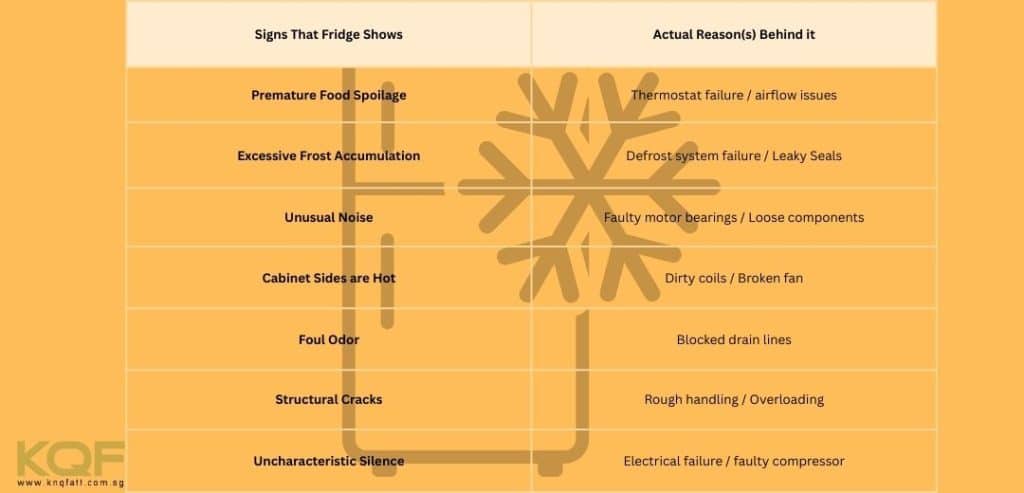
This occurs when your fridge fails to maintain the correct temperature to keep food fresh. You may notice vegetables wilting faster, milk souring prematurely, or meat becoming unsafe to serve. This can be due to damaged door seals that allow warm air to seep in, faulty thermostats, or refrigerant leaks reducing the cooling capacity.
Causes: Thermostat failure, low refrigerant levels, poor insulation, or airflow issues.
Refrigeration Parts to Check: Thermostat, door gaskets, refrigerant line.
Is it repairable? Yes. In most cases, replacing the thermostat or recharging refrigerant can restore functionality. Gasket replacements are also cost-effective fixes.
If your refrigerator starts to “sweat” or you notice moisture droplets forming on the outer surface, it’s a sign that warm, moist air is entering the cabinet. This could lead to water pooling at the base, creating slipping hazards and electrical risks. Often, the root cause is a compromised door seal or a clogged or cracked drip tray.
Causes: Humid air infiltration due to broken door gaskets or insulation failure.
Refrigeration Parts to Check: Door seals, drip tray, insulation lining.
Is it repairable? Yes, but immediate action is advised. Door gasket replacement is straightforward, while insulation issues may require more intensive intervention.
A commercial fridge should have an automatic defrost function. When that fails, you’ll notice thick layers of frost on walls or food containers. This often points to problems in the defrost heater, thermostat, or door seals allowing moisture inside.
Causes: Defrost system failure, open door, or leaky seals.
Refrigeration Parts to Check: Defrost heater, timer, evaporator coil.
Is it repairable? Yes, but depending on the part, labor intensity varies. Replacing the defrost heater or fixing the seal usually resolves the issue.
Loud humming, buzzing, or clanking sounds can indicate mechanical issues like a failing condenser fan, malfunctioning compressor, or clogged evaporator. These noises are early warning signs that internal components are struggling to perform efficiently.
Causes: Faulty motor bearings, ice obstruction, or loose components.
Refrigeration Parts to Check: Condenser fan motor, evaporator fan motor, compressor.
Is it repairable? Often yes, but compressor-related issues may be costlier and need professional handling.
While most people worry about loud noises, a fridge that suddenly becomes completely silent can also indicate trouble. If your unit was previously humming and now shows no sound, the compressor may have failed or the control board might be unresponsive.
Causes: Electrical failure, burnt relay, or faulty compressor.
Refrigeration Parts to Check: Start relay, control board, compressor.
Is it repairable? It depends. Relay replacements are affordable; compressor issues can be more serious.
If the exterior sides of the fridge feel warmer than usual, this could mean poor heat dissipation. The condenser coils may be clogged with dust or the fan responsible for cooling those coils has malfunctioned.
Causes: Dirty coils, broken fan, or restricted airflow.
Refrigeration Parts to Check: Condenser coils, condenser fan motor.
Is it repairable? Yes. Cleaning coils is simple, and fan motor replacement is routine for professionals.
Structural Cracks
Visible cracks inside the refrigerator walls or shelving not only compromise hygiene but may also affect temperature retention. In some cases, cracked linings can allow moisture buildup, contributing to mold or water damage.
Causes: Age-related wear, rough handling, or overloading.
Refrigeration Parts to Check: Interior lining, shelving mounts.
Is it repairable? Minor cracks can be sealed, but extensive damage may require panel or liner replacement.
Commercial fridges generally last 8–12 years. If your unit is older than 10 years and frequently breaking down, it’s a strong signal to either repair or replace. Older models are also less energy efficient and may not comply with NEA’s latest energy standards.
Causes: Natural wear and tear.
Refrigeration Parts to Check: Multiple – performance audit needed.
Is it repairable? Possibly, but cost-effectiveness should be evaluated against replacement.
Persistent bad smells, even after cleaning, suggest mold buildup, spoiled food particles stuck in the drain line, or refrigerant leaks. These odors can make your kitchen unhygienic and even unsafe. Causes: Blocked drain lines, mold growth, chemical leaks.
Refrigeration Parts to Check: Drain pan, drain line, evaporator area.
Is it repairable? Yes, but you may require professional drain cleaning or leak detection services.
The cost of commercial refrigerator repair in Singapore can range widely, typically from S$80 for minor fixes to S$800 or more for complex component replacements. Understanding what drives these costs is essential for making informed decisions—especially for business owners managing restaurants, bakeries, or convenience stores where downtime can quickly translate to revenue loss.
Several factors determine the overall repair cost of a commercial refrigerator. These include the type of unit, brand and parts availability, the nature of the problem, and whether the repair is emergency or scheduled. Let’s explore these in more detail:
Different types of refrigerators have different complexities. A standard upright chiller may be simpler to repair than a walk-in cooler or a dual-zone freezer, both of which require specialized parts and extended labor hours.
Well-known commercial brands like Kinco, Kerry, Yuda, or KQF (locally used) often have better part availability in Singapore. Rare or imported models may require custom ordering, extending downtime and cost.
Not all issues are equal. A simple thermostat replacement might cost around S$120–S$180, while a compressor replacement—a labor-intensive, part-sensitive repair—can exceed S$500.
Emergency repair services, especially after-hours or same-day appointments, generally cost more. You can expect 20–50% markup for urgent calls.
In Singapore, if a restaurant’s chiller fails on a Friday evening, calling for emergency repair could cost S$100–S$200 more than waiting until Monday. Travel surcharges may also apply depending on the location (e.g., Sentosa or offshore facilities).
Repairs conducted in central districts (e.g., Orchard or Marina Bay) may include parking and access fees, while units located in tight utility rooms or basement kitchens could require more labor. Businesses located in industrial areas with easier service bay access may benefit from faster and cheaper repairs.
Prices for commercial-grade parts such as fans, thermostats, defrost heaters, or compressors fluctuate depending on supply chain conditions. In Singapore, rising import duties and material prices can influence these costs.
Labor typically makes up 40–60% of total repair costs. Several factors influence this:
When a commercial refrigerator malfunctions, the type of problem heavily influences both the complexity of the fix and the cost. In Singapore, repair prices are impacted by labor, parts availability, and urgency—but the core driver remains the nature of the fault.
Here’s a detailed, Singapore-based breakdown of common refrigeration issues and their respective repair costs. Each section aligns with the problems mentioned earlier, allowing businesses to estimate potential expenses and plan ahead.
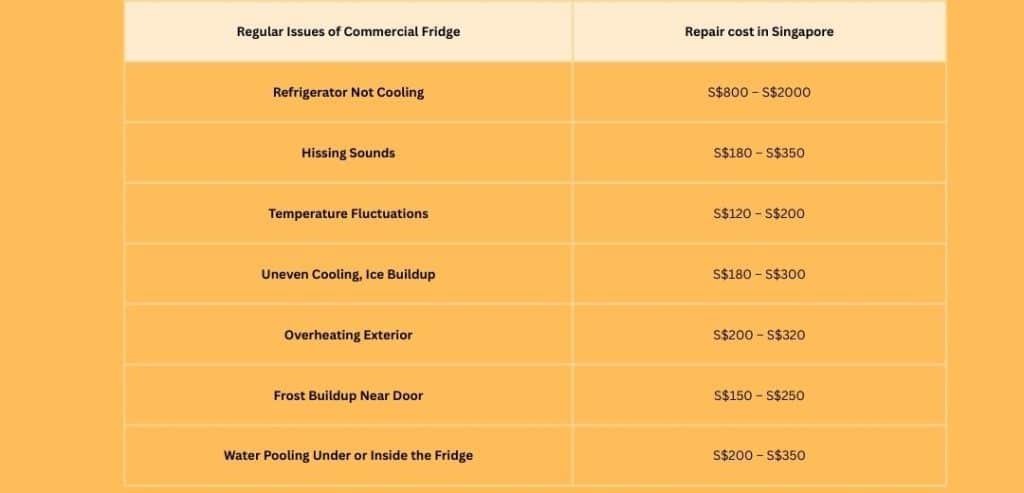
These symptoms often point to deeper mechanical issues, most notably involving the compressor or thermostat.
The compressor is the heart of your cooling system. If the fridge doesn’t cool and you hear clicking or buzzing noises, the compressor may be faulty.
Typical cost in Singapore: S$800 – S$2000
Includes: Part replacement, refrigerant recharge, and testing.
Repair time: 3–5 hours.
Part brands available: Secop, Embraco, Danfoss (commonly used in Singapore).
Leaks reduce cooling efficiency and can lead to frost or ice buildup. Hissing noises from the back or bottom of the unit are common indicators.
Typical cost in Singapore: S$180 – S$350
Includes: Leak detection, sealing, and refrigerant recharge (usually R404A or R134a).
Is it urgent? Yes — refrigerant loss reduces cooling immediately and affects stored products.
If temperatures vary wildly or the unit fails to regulate cooling, the thermostat may be faulty.
Typical cost in Singapore: S$120 – S$200
Time required: ~1 hour
Commonly compatible brands: Dixell, Eliwell
This fan distributes cool air inside the cabinet. If it fails, parts of the fridge may be warm while others are too cold.
Cost in Singapore: S$180 – S$300
Includes: Diagnosis, fan motor, and labor.
Common signs: Ice accumulation near the fan or loud whirring sounds.
This fan helps release heat from the condenser coils. Failure leads to excessive heat on the cabinet sides and compressor strain.
Cost in Singapore: S$200 – S$320
Brands: Yuda, Kerry
Is it urgent? Yes — overheating can shorten compressor life.
Worn door seals let warm air in and force the unit to work harder. They also cause condensation and frost buildup.
Cost in Singapore: S$150 – S$250
Custom seals: Some models may need custom-molded gaskets.
Repair time: 30–60 minutes.
A failed heater won’t melt frost during defrost cycles, leading to ice overloading.
Cost in Singapore: S$180 – S$280
Includes: Heater, wiring check, defrost timer calibration.
Downtime: Typically 1 business day.
The control board acts as the brain of your unit. It regulates everything from temperature to defrost cycles.
Cost in Singapore: S$250 – S$400
Includes: Diagnosis, board replacement, system reset.
When is replacement better? If your fridge is over 10 years old.
A faulty relay prevents the compressor from powering up.
Cost in Singapore: S$120 – S$180
Quick fix? Yes. This is one of the most affordable fixes and often misdiagnosed as a dead compressor.
A clogged drain line causes overflow from defrost cycles, leading to puddles under or inside the unit.
Cost in Singapore: S$200 – S$350
Includes: Drain cleaning, unclogging trap, checking tilt angles.
Health impact: Standing water can attract pests and mold.
Lights are often LED in newer models, requiring panel or driver replacement.
Cost in Singapore: S$240 – S$480
Downtime: Minimal. May be fixed during routine service.
Water valve, line, or icemaker unit itself could be the issue.
Cost in Singapore: S$280 – S$580
Includes: Part replacement or valve repair.
Applies to: Commercial undercounter or modular ice makers.
If no specific part has failed but noise persists, a technician may need to tighten components or lubricate moving parts.
Cost in Singapore: S$100 – S$160
Common causes: Fan blades hitting ice, worn-out bearings, or faulty relays.
Sometimes the display unit itself malfunctions, not the control board.
Cost in Singapore: S$150 – S$280
Includes: Panel replacement, calibration, and function test.
Brands: Dixell, Carel, and other smart display units.
| Problem | Repair | Estimated Cost (SGD) |
| Not cooling / cycling / noise | Compressor Replacement | S$450 – S$800 |
| Poor cooling + frost | Refrigerant Leak Repair | S$180 – S$350 |
| Temp fluctuations | Thermostat Replacement | S$120 – S$200 |
| Uneven cooling | Evaporator Fan Motor | S$180 – S$300 |
| Overheating sides | Condenser Fan Motor | S$200 – S$320 |
| Door frost / energy bill spike | Door Seal Replacement | S$80 – S$150 |
| Constant running, frost | Defrost Heater | S$180 – S$280 |
| No response, display issues | Control Board | S$250 – S$400 |
| No start / stopping soon | Start Relay | S$120 – S$180 |
| Water leakage | Drain Line Clearing | S$80 – S$150 |
| Dim lights | Light Fixture | S$60 – S$120 |
| Ice not forming | Icemaker Repair | S$150 – S$300 |
| Buzzing / clicking sounds | Noise Troubleshooting | S$90 – S$160 |
| Display error | Display Panel | S$150 – S$280 |
A walk-in cooler is a crucial storage unit for high-volume commercial kitchens, cloud kitchens, central warehouses, and large-format F&B establishments in Singapore. When it starts underperforming, identifying and repairing issues quickly can prevent product losses and operational setbacks.
Common signs that your walk-in cooler needs repair include inconsistent temperature, frost buildup on evaporator coils, water pooling, and compressor noises. If food doesn’t remain cold enough, or if you notice mold, strange smells, or rising electricity bills, it may indicate poor insulation, refrigerant loss, or fan motor failure. On average, walk-in coolers in Singapore should be professionally serviced every 3–6 months, especially in humid environments like kitchen backrooms or outdoor storage units. Routine inspections can prevent larger issues and keep your business compliant with SFA hygiene standards.
To find a reliable walk-in cooler repair service in Singapore, look for NEA-compliant service providers with transparent pricing, strong customer reviews, and local inventory support. Businesses in Changi, Clementi, or Woodlands may face different travel and scheduling fees, depending on technician availability and proximity. As always, ensure the technician is familiar with your brand and model.
Several elements influence repair pricing:
Other elements such as travel time, number of technicians required, and access difficulty directly affect pricing. For example, a cooler installed in a tight urban café may need 2 technicians, raising labor cost. Similarly, parts such as compressors or evaporator coils can be expensive if replacements are needed—especially when ordered through international supply chains.
Routine maintenance not only helps extend the life of your walk-in cooler but also reduces long-term repair costs. Regular cleaning of evaporator coils, checking refrigerant pressure, and inspecting electrical terminals can catch issues early before they spiral into costly breakdowns.
Unexpected refrigerator breakdowns can be financially painful, especially for restaurants, hotels, and food production businesses where temperature control is critical. But the good news? Most surprise repair costs can be avoided with proactive planning, proper scheduling, and an understanding of what puts strain on your equipment.
Routine servicing is the most effective way to reduce major repair bills. A technician can identify early signs of failure—such as worn-out door gaskets, weak airflow, or clogged condenser coils—before they become full-blown issues. Neglected components like dirty coils or failing fans force the unit to overwork, leading to higher utility costs and premature part failure. Going through commercial fridge maintenance checklists regularly is particularly important in Singapore, where high humidity levels and ambient kitchen heat put extra stress on refrigeration units.
Being able to spot minor issues early can save you thousands in downtime and repair charges. Watch for:
Older commercial fridges tend to draw more power and break down more frequently. Investing in energy-efficient models and claiming support under Singapore’s Energy Efficiency Grant (EEG) can save operational costs in the long run. Proper servicing also ensures your fridge is not consuming excess energy due to inefficiencies like refrigerant leaks or poor insulation.
In a tropical climate like Singapore, where kitchens often run hot and humid, commercial refrigerators require more frequent checks than in cooler countries. The type of unit, usage volume, and business type influence servicing needs.
Even with top-tier appliances, maintenance is not optional—it’s strategic. Catching a small defrost timer fault today might save you from replacing an entire control board tomorrow.
Want to learn more about keeping your commercial fridge in peak condition? Read our full guide on how to maintain commercial refrigerators in Singapore.
What is the difference between DIY vs Professional Repair & Maintenance Service?
When your commercial refrigerator starts acting up, the natural question is: Should I fix this myself or call a professional? While DIY repairs can be tempting—especially for minor issues—commercial refrigeration systems are far more complex than domestic units. The difference between DIY and professional service lies in diagnostic accuracy, safety, efficiency, and long-term reliability.
DIY fridge repair might be suitable for surface-level maintenance like:
These tasks require minimal tools and carry low risk. But once electrical systems, refrigerant levels, or temperature sensors are involved, DIY can do more harm than good.
Attempting to fix a refrigerant leak without the right equipment not only violates Singapore’s environmental regulations but may also void your product warranty or lead to safety risks like electrocution or gas exposure.
Moreover, commercial refrigerators often have brand-specific diagnostic codes or embedded control boards that require specialized tools and firmware access. These aren’t available to end-users.
Licensed technicians have access to proper diagnostic equipment, refrigerant handling certification, and part compatibility databases. They can:
For example, a silent compressor might seem like a simple relay problem to the untrained eye—but a technician would test the control board, capacitor, and voltage flow before confirming the root cause. That’s the difference between guesswork and technical expertise.
Professional services also offer documented proof of repairs, which is critical for inspections, audits, or claiming warranties under the Energy Efficiency Grant (EEG) program.
In short, while DIY might save you a few dollars today, professional repair is an investment in safety, performance, and business continuity.
When a commercial refrigerator breaks down, time is critical. That’s where KnQ Fatt’s repair and maintenance team has consistently delivered for Singaporean businesses across the F&B and retail industries. With years of hands-on experience in repairing everything from compact chillers to full-scale walk-in coolers, KnQ Fatt is trusted by cafés, restaurants, hotels, and supermarkets to minimize downtime and keep cold chain operations running smoothly.
Our team provides transparent pricing—no hidden charges, no inflated weekend surcharges. We believe business owners should know the cost upfront, which is why we offer diagnostics before commitment. You’ll understand exactly what’s wrong, what needs fixing, and what the most efficient solution is—before we begin the work.
We’re equipped to service all major commercial refrigeration brands commonly used in Singapore, including KQF, Kinco, Kerry, Yuda, and Scotsman. Whether you’re dealing with a condenser fan failure, refrigerant leak, or thermostat malfunction, our technicians carry original or compatible replacement parts to get your system back online fast.
More than just reactive repair, our maintenance program is designed to help you stay ahead of breakdowns. We follow a structured checklist, including:
Every service comes with a post-repair performance check, ensuring your refrigerator is operating at its optimal efficiency. In Singapore’s humid climate, this attention to detail prevents energy loss, reduces long-term repair costs, and helps businesses maintain NEA and SFA compliance.
If you’re unsure when your unit was last serviced, it might be time. Don’t wait for a breakdown—schedule a routine check with KnQ Fatt today.
